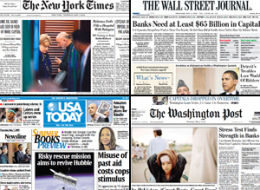
 Over the past weekend, Warren Buffett was asked about the newspaper business. He basically said he would not invest in the industry at any price. It does seem that the industry is going the way of buggy-whip manufacturers. The demand for good old-fashioned, delivered-to-your-home-and-read-at-the-breakfast-table papers is disappearing quickly. It is just too easy, as well as free, to read the news on the Internet.
I read three or four papers a day of the old-fashioned variety, but even I question the wisdom of paying $2 a copy for The New York Times when I can read for free at the click of a mouse. The business model of the newspaper business just does not work anymore.
Many of the companies simply could not conceive that the party would ever end. They loaded up their balance sheets with debt, convinced there would always be adequate cash flow to service the annual interest payments. As the Internet gained momentum and we were hit by the recession, the falsehood of that assumption became apparent.
Both Tribune Co. (TRBCQ) and Sun Times (SUTMQ) in Chicago have filed for bankruptcy in the past year. New York Times Co. has struggled, slashing its dividend and selling property, including its Manhattan headquarters, to survive as revenue declined. It appears McClatchy is hanging on by a thread right now, as is Lee Enterprises. Bankruptcies, layoffs and plant closures have dominated the industry since the recession hit. More layoffs and closings are expected between now and the end of the year.
The questions become, which companies will survive and in what form will they prosper? Clearly, the papers will have to offer content online. It remains to be seen if online advertising for daily papers will replace current print ad revenue. How they make money from online content is going to be the biggest puzzle the management of the industry will have to solve. They will have to begin charging readers for content at some point, in my opinion. It just seems ridiculous that I can read the paper free online but have to pay for a print copy. To keep high-quality reporting and writing, they have to pay decent salaries. To mountain quality, they simply have to start charging.
Clearly, News Corp. is going to be a survivor. The publisher of The Wall Street Journal and several other daily papers in the U.S. has some significant advantages. First, of course, are the media and entertainment assets the company also owns. In addition to the Fox film and television divisions, News Corp. has four papers in the U.K. and more than 100 in Australia.
Rupert Murdoch has proven to be adept at managing the assets and capital structure of the company, and I expect him to continue to do so. In addition to supporting its newspapers with other cash-producing divisions, the company has managed to make The Wall Street Journal's online operation work. This is the only daily paper I am aware of that successfully charges readers for access to content.
I think New York Times Co. survives, simply because I cannot imagine a world without the Times. It will not be in its current form, however. The company is going to have to restructure, sell still more assets and shed some of the debt load from the books. It will also have to start charging for online access. A bankruptcy restructuring for the Gray Lady would not surprise me in the near future. This would not only allow the company to purge the debt in favor of equity, it could also deal with union labor costs under the umbrella of the courts. I do not believe the stock is a good buy at these prices, but the debt is getting interesting with yields in the teens. If the outstanding bond issues trade down even further, they may well be worth a look.
Gannett is a likely survivor as well. In the long run, its flagship national daily, USA Today is probably going to benefit from the wave of closings we have been seeing. Without a local daily, readers will turn to the national paper for news. In addition to the papers, Gannett has 23 network television stations and a new online division. It is by no means exempt from the problems facing the industry, but I believe it survives and emerges from the recession in a strong position. Although the stock has tripled off its March lows, it sells for less than 10% of what the shares fetched just two years ago.
Washington Post Co. is going to survive as well. The company has cable and television operations, in addition to the Kaplan Educational division that supports the struggling newspaper. The Post is struggling amid a recently reported loss, as ad revenue fell by 33% year over year. The other divisions should generate enough cash flow to allow the Post to survive and cause morning heartburn for Washington officials for years to come. The shares are worth a look if you have a long time horizon, especially if they fall back toward the yearly lows.
The newspaper industry is going to change dramatically. Many more publishers will disappear. I suspect that there will be more of an electronic presence for the industry and that daily papers will be replaced by the regional and national editions of the survivors. Unlike buggy whips, the demand for news is not going to go away. Figuring out the survivors of the group could lead to profits as the economy recovers.


