Showing posts with label Barack Obama. Show all posts

Barack Obama sees worst poll rating drop in 50 years

0 comments
The decline in Barack Obama's popularity since July has been the steepest of any president at the same stage of his first term for more than 50 years.
 
Barack Obama's popularity has fallen steeply since being elected last year
Barack Obama's popularity has fallen steeply since being elected last year Photo: AFP
Gallup recorded an average daily approval rating of 53 per cent for Mr Obama for the third quarter of the year, a sharp drop from the 62 per cent he recorded from April.
His current approval rating – hovering just above the level that would make re-election an uphill struggle – is close to the bottom for newly-elected president. Mr Obama entered the White House with a soaring 78 per cent approval rating.
The bad polling news came as Mr Obama returned to the campaign trail to prevent his Democratic party losing two governorships next month in states in which he defeated Senator John McCain in last November's election.
Jeffrey Jones of Gallup explained: "The dominant political focus for Obama in the third quarter was the push for health care reform, including his nationally televised address to Congress in early September.
"Obama hoped that Congress would vote on health care legislation before its August recess, but that goal was missed, and some members of Congress faced angry constituents at town hall meetings to discuss health care reform. Meanwhile, unemployment continued to climb near 10 per cent."
Governor Jon Corzine of New Jersey is in severe danger of defeat while Democrats are fast losing hope that Creigh Deeds can beat his Republican opponent in Virginia. Twin Democratic losses would be a major blow to Mr Obama's prestige.
Campaigning for Mr Corzine in Hackensack on Wednesday night, Mr Obama delivered a plea that almost seemed as much for himself as the local candidate: "I'm here today to urge you to cast aside the cynics and the sceptics, and prove to all Americans that leaders who do what's right and who do what's hard will be rewarded and not rejected."
Mr Corzine, a former Goldman Sachs executive and multi-millionaire, is currently running even in New Jersey, which is normally comfortably Democratic, while Mr Deeds is trailing badly in Virginia, a swing state that was key to Mr Obama's 2008 victory.
Mr Obama is also facing widespread criticism for his drawn-out decision-making process over what to do next in Afghanistan.
Republicans sense Mr Obama is in a vulnerable position and this week saw the return to the public stage of his perhaps most vehement opponent – Vice-President Dick Cheney.
In a blistering speech on Wednesday night, he accused Mr Obama of failing to give Americans troops on the ground a clear mission or defined goals and of being seemingly "afraid to make a decision" about Afghanistan "The White House must stop dithering while America's armed forces are in danger," Cheney said at the Center for Security Policy in Washington.
"Make no mistake, signals of indecision out of Washington hurt our allies and embolden our adversaries."
He hit out at Obama aides who suggested that the Bush administration had failed to weigh up conditions in Afghanistan properly before committing troops.
"Now they seem to be pulling back and blaming others for their failure to implement the strategy they embraced. It's time for President Obama to do what it takes to win a war he has repeatedly and rightly called a war of necessity."

Barack Obama warns US teenagers of the dangers of Facebook

0 comments
President Barack Obama warned American teenagers of the dangers of putting too much personal information on Internet social networking sites, saying it could come back to haunt them in later life when they started to seek employment.

Barack Obama: Barack Obama warns US teenagers of the dangers of Facebook
US President Barack Obama delivers a national address directed to students across the nation, at a back to school event at Wakefield High School in Arlington, Virginia Photo: EPA

The presidential words of advice follow recent studies that suggested employers are increasingly turning to sites such as Facebook and MySpace to conduct background checks on job applicants.
Taking part in a question-and-answer session with a group of 14- and 15-year-old school students, Mr Obama was asked by one pupil for some advice on becoming president.
“Well, let me give you some very practical tips. First of all, I want everybody here to be careful about what you post on Facebook, because in the YouTube age, whatever you do, it will be pulled up again later somewhere in your life,” Mr Obama said.
“And when you’re young, you make mistakes and you do some stupid stuff.
And I’ve been hearing a lot about young people who - you know, they’re posting stuff on Facebook, and then suddenly they go apply for a job and somebody has done a search.”
Mr Obama referred several times to “mistakes” he had made when he was at school but offered no specifics. He has previously admitted to drug use when he was younger.
The session with students was held after Mr Obama delivered a speech at a high school in Arlington, Virginia, which aroused controversy before hand.
Conservative critics claimed the president was trying to “indoctrinate” the nation’s schoolchildren, though his address proved to be no more than an eloquent exhortation to work hard and finish school.
A survey in June by careerbuilder.com found that 45 percent of employers used social network sites to research job candidates and that Facebook, which says it has 250 million users worldwide, was their site of choice.
Some 35 percent of the employers surveyed said they had found content on the sites that had influenced them to reject a candidate. Examples included inappropriate photographs, information about the applicants’ drinking or drug use, or bad mouthing of previous employers, co-workers or clients.
The Obama White House frequently uses Facebook, Twitter and other social networking sites to bypass the media and communicate directly to Americans.

Obama makes clear his feelings about Myanmar court decision

0 comments
President Barack Obama has expressed his concern at the decision by a Myanmar court to extend democracy leader Aung San Suu Kyi's house arrest by another 18 months.

He said the sentence was patently unjust and should be immediately overturned.

He claimed the trial outcome would have a negative impact on the administration's review of policy toward Myanmar.

Up to now, the Obama administration had been considering greater engagement with the military authorities in Myanmar, but officials have said the conviction and sentencing of Aung San Suu Kyi for violating terms of her long-running house arrest will negatively affect the results of the discussions.

The latest case against the democracy leader followed an incident involving an American citizen, John Yettaw, who made an uninvited visit to her home in May.

Mr Yettaw was sentenced at the same time as Ms Suu Kyi to seven years in prison.

President Obama also called the sentencing of Mr Yettaw for the home invasion as being out of proportion with his actions.

The international community is also putting pressure of the Myanmar government to release Aung San Suu Kyi.

British Prime Minister Gordon Brown has called the sentence "monstrous," and said the trial process had been a "sham."

French President Nicolas Sarkozy denounced the court ruling as "unjust and unfair."

Human rights group Amnesty International also condemned the verdict, calling it "shameful."

United Nations Secretary General Ban Ki-moon has issued a statement to say that unless Aung San Suu Kyi and all other political prisoners are released, the credibility of the Myanmar’s upcoming political process will remain in doubt.

Anti-Obama Merchandise Surges Amid Growing Doubts Over Obama's Policies

0 comments
Popular slogans such as "Mama for Obama" have been retooled to "To the Mama for Obama -- thanks for the tax hike."

A new wave of anti-Obama memorabilia is hitting the shelves -- from T-shirts to bumper stickers to buttons -- as the president's economic and health care policies divide the nation.
Popular slogans such as "Mama for Obama" have been retooled to "To the Mama for Obama -- thanks for the tax hike."
"Yes, we can" has become "No, he can't."
"The Audacity of Hype" has replaced the title of Obama's popular book, "The Audacity of Hope."
"It really started peaking about a month ago," Amy Maniatis, vice president of marketing at the online seller Cafepress.com, told The Washington Times.
"You see it as a direct response to some of the promising messages that happened a year ago. Whereas we had the campaign of Obama centered around hope, and it was a very optimistic message, now they're asking: 'How's that hopey-changey thing going?'"
The Cafepress.com store offers about 3 million Obama products, she said, but now is up to about 1 million that are "anti-Obama-oriented," reflecting a "significant shift in the last couple of months than what was the trend a year ago."
Pro-Obama merchandise is still selling well, she said, "but now we're seeing a much larger swing toward the critical designs. It will be lighthearted as commentary on his gaffes as in 'Acted Stupidly,'" a play on his remarks about the Cambridge, Mass., police who arrested Harvard scholar Henry Louis Gates Jr., "or with folks reacting to headlines or what is going on with the economy."

The Democrats' senior problem

0 comments
Democrats have a senior citizen problem.

Frustrated older Americans are packing the town halls on health care. They are incredibly passionate about their Medicare benefits. Polls show senior citizens largely disapprove of health care reform ideas so far.

And of course, they vote — in larger numbers than any other demographic.

But so far, Democrats have focused much of their health care sales pitch on middle-class Americans and the uninsured — a slight that has been noticed by senior citizens, who hold great influence with members of Congress.

At his Tuesday town hall event in New Hampshire, President Barack Obama made a point to reach out to seniors, noting the low support in polls for his health care proposals.

“We are not talking about cutting Medicare benefits,” Obama said, trying to assuage the audience.

But Obama is talking about finding hundreds of billions in savings from Medicare — cuts supporters say will trim fat from the program — including slashing $156 billion in subsidies to Medicare Advantage, a privately administered Medicare program.

“Seniors are one of the most attentive and engaged constituencies, especially on health care issues, and we’ve seen that in the Medicare Advantage programs,” said Robert Zirkelbach, a spokesman for America’s Health Insurance Plans.

A July 31 Gallup Poll found that just 20 percent of Americans aged 65 and older believe health care reform would improve their own situation, noticeably lower than the 27 percent of 18- to 49-year olds and 26 percent of 50-to-64-year-olds who say the same.

The senior citizen problem could pose a serious problem for the 2010 election cycle.

Older Americans turn out in much higher numbers than other age groups during midterm elections. In 2006, the 55-and-older age group still had the highest voting rate of any age group, at 63 percent, even though younger voters turned out in record numbers for a midterm, according to census data. Half of all votes cast in the 2006 midterms were from voters age 50 or older, according to AARP. And one out of four were AARP members.

But voting statistics tell only part of the story. Look at the faces at these chaotic congressional town hall events across the country. They are the faces of older Americans who paid into Medicare most of their working lives and are now enjoying the health care benefits they believe they’ve earned for their senior years.

They exhibit a vocal distrust of the government taking a larger role in health care — despite the fact that the very popular Medicare program is run by the government.

Obama’s problem with senior citizens isn’t new. Polls showed that John McCain bested Obama among seniors, even though Obama made gains across almost every other demographic.

Some experts say the real problem is that Democrats haven’t done enough to address seniors’ concerns to date, allowing the perception to grow that seniors will lose under reform.

Proponents haven’t talked enough about how health reform will benefit seniors, said Jeff Blum of USAction, a progressive grass-roots organization pushing health reform.

“We were vulnerable, and that was a mistake on the part of us promoting health reform,” Blum said. “The opposition found an opportunity and ran with it.”

Critics say the proposed $380 billion Medicare cuts in the House bill — including cuts to the privately administered Medicare Advantage program — will lead to long waits for care, doctors dropping patients and doctors deciding if their older patients “are worth the cost,” as one TV and Web ad from the 60 Plus Association warned.

Kenyan Birth Certificate: Obama Birthers Latch On To Forgery

0 comments
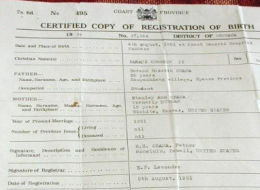
Kenyan Birth CertificateThe latest development in the Obama "birther" conspiracy is the emergence of a "Kenyan birth certificate" for the president, put online by movement maven Orly Taitz.

Oddly, the same people who are so skeptical of Obama's Hawaii birth certificate are willing to accept this new document despite many flaws, documented by the Washington Independent's Dave Weigel and Markos Moulitsas.
Here are just some of the flaws:
Kenya was a Dominion the date this certificate was allegedly issued and would not become a republic for 8 months.
Mombasa belonged to Zanzibar when Obama was born, not Kenya.

Obama's father's village would be nearer to Nairobi, not Mombasa.

The number 47O44-- 47 is Obama's age when he became president, followed by the letter O (not a zero) followed by 44--he is the 44th president.
EF Lavender is a laundry detergent.
In spite of the document's many problems, Taitz has submitted it to a court as part of her case against the president.
"I'm forcing the issue, where Obama will have to respond," she told World Net Daily.
"Before, they said, 'You don't have anything backing your claims,'" Taitz explained. "Now I have something. In fact, I have posted on the Internet more than Obama has. My birth certificate actually has signatures."
Karl Rove responded to the circulation of the new paper on Twitter, saying "I believe this is likely a forgery."

Obama says state sovereignty is important, but there will be exceptions to the rule

0 comments
Obama: Important to respect state sovereignty
L’AQUILA, Italy — President Barack Obama says respecting the sovereignty of nations is important, but that some “exceptional circumstances” — like genocide — require an international response.

Speaking in Italy at the conclusion of a summit of the world’s developed countries, Obama said in response to a question that getting involved in a country’s internal affairs would not always be a “neat decision” because other countries would object.
But he also said there will be exceptions.
The president said that genocide in Rwanda was an example of a crisis that made international intervention a moral imperative.

The Obama Government: Take From The Poor And Give To The Rich

1 comments
By Ann Robertson

These past several weeks have witnessed a stunning attack on working people, with the Obama administration leading the charge.
It started with Larry Summers, Obama’s chief economic adviser, responding to the A.I.G. bonuses by pontificating about the sanctity of contracts: “We are a country of law. There are contracts. The government cannot just abrogate contracts.” Like a mad dog pursuing its prey, he pounced on the conclusion that absolutely nothing could be done about the bonuses. Unfortunately, Summers voiced no similar outcry when the Obama administration, only weeks earlier, insisted that the U.A.W. contracts be renegotiated as a condition for the auto industry receiving a bailout, suggesting that a different set of rules applies to the rich than to the rest of us who constitute the majority and work for a living.
However, when a public uproar swept the country in response to these bonuses, many of which were ear-marked for the financial wizards who helped drive the economy over the cliff, the Obama administration executed a hasty about-face. Suddenly, they too were “outraged,” along with everyone in Congress who wanted to keep alive any chance of re-election.
But then, Eliot Spitzer, former New York governor, weighed into the fracas, arguing that the bonuses were only the tip of the iceberg. The real scandal, he claimed, centers on A.I.G.’s decision to redirect billions of its public bailout funds to some of its trading partners, including Goldman Sachs. For weeks, A.I.G. had refused to divulge the names of these recipients and only acquiesced when threatened with legal action. According to Spitzer, the issue is basically this: if taxpayers are being forced to sacrifice by bailing out financial institutions, shouldn’t the financial institutions themselves be compelled to make their own sacrifices rather than being made completely whole by taxpayer money, as is happening when Goldman Sachs receives taxpayer money from A.I.G.? And one could add that, after all, the financial institutions had some responsibility in creating this financial disaster; we working people had nothing to do with it.
But even these setbacks for working people pale in comparison to the latest dog and pony show orchestrated by the Obama administration in response to the toxic assets that are dragging down the financial institutions here in the U.S. and around the world. As Paul Krugman, Princeton economist, observed: “…basically the plan hands out gold-plated toasters to anybody who participates.” Joseph Stiglitz, Nobel Prize-winning economist, described it as “very badly flawed,” offering “perverse incentives,” that amount to “robbery of the American people.”
Basically, the program, which is trumpeted as a public-private partnership, will give billions of dollars of our taxes to subsidize private investors who buy the toxic assets. We will contribute 94 percent of the cost, leaving only 6 percent that the private investors must shoulder. If the toxic assets prove to be worthless, as their name suggests, we taxpayers will suffer heavy losses while the investors can walk away almost painlessly. However, if these assets turn out to be profitable, then the investors and taxpayers share in the proceeds on a 50-50 basis, not on the basis of 94-6, as one would think if fairness marked the bottom line. This kind of partnership resembles the kind that exists between predators and their prey. Or, as Paul Krugman noted, it’s like this: heads the private investors win, tails the public loses. Once again a different set of rules applies to rich as opposed to the rest of us.
All of the above can be summarized in this way: as long as the markets operate to make the rich even richer, we must consider them sacred. However, when they fail to deliver this outcome, the government must step in and, with our tax money, insure that the rich can continue their ascent to ever-greater heights of wealth while the rest of us languish in the dust, struggling to buy a home, keep a job, provide a decent education for our children, secure health coverage for ourselves and our family, and so on.
Finally, many of us harbor the illusion that when it comes to paying taxes, the rich carry the heavier burden. As Dorothy Brown recently pointed out: “There are effectively two tax systems in America: one for the very rich and one for the rest of us. Income from stock dividends and capital gains, which makes up a disproportionate amount of the earnings of the very rich, is taxed at 15 percent. But the bulk of what the rest of us earn — wages and interest from savings accounts — is taxed at up to 35 percent.” For this reason, billionaire Warren Buffett, to his credit, has complained that he was taxed at a rate of 17.7 percent on his $46 million income while his secretary struggled under the onerous rate of 30 percent.
The government has embraced two sets of rules: one for the rich and another for the rest of us. Working people will have to organize themselves so that they can forcefully demand, not only a bailout for working people, but an entirely new and just set of rules that level the playing field. But they will have to come to the realization that the root of the problem lies in the fact that this is a class society, and anything of significance happens on that basis.
On the one hand, the rich own the economy and run it exclusively in their own interests in pursuit of the maximization of profits, regardless of the pain and suffering they inflict on the rest of us and the environment. They lay us off, foreclose our homes, and deprive us of health care without a second thought. And by giving millions of dollars to politicians, they in essence run the country, secure in the knowledge that the politicians will return the favor with preferential legislation and bailouts on demand.
On the other hand, working people labor long and hard only to be told that we are being laid off, or our pension has disappeared, or we have lost our savings on a stock market that operates according to unfathomable principles.
We must insist that the country operate in the interests of the majority. But this goal requires that we embrace truly democratic principles so that every important economic decision is discussed, debated, and determined by a vote. Only then will we succeed in abolishing classes, abolishing the privileges of the rich, and establishing a society where the full development of every individual is the fundamental premise embraced by all.
Ann Robertson is a teacher at San Francisco State University and a writer for Workers Action (www.workerscompass.org). She can be reached at aroberts45@aol.com

Obama phoned Bush before declaring Iraq plan

0 comments
Washington, Feb 28: US President Barack Obama made a telephone call to his predecessor George W Bush to inform him about his decision to withdraw all troops from Iraq by the year 2011 and end the combat mission by August 2010.

White House spokesman Robert Gibbs said that Obama before making the announcement on Iraq placed a call to the former President George Bush" as a courtesy to let him know" about his decision.

"It was a fairly straight forward call," he said, adding it lasted somewhere about five minutes.

"They talked a bit about that (Iraq), and in the end President Obama asked President Bush how he was enjoying his new endeavour and whether they'd moved into the new house. So they talked a couple of minutes about that," Gibbs said.

Obama, however, did not make calls to other former US Presidents, Gibbs said, while responding to question on this issue.

"I think obviously this was something that was a pretty big issue for the most previous President, and because of that, felt it important to call and let him know," he said.

The White House spokesman, however, could not say what was the reaction or comment from Bush on this issue. "I could only hear one side of the conversation," he said.

Obama & Pakistan: Reluctance To Call A Spade A Spade

0 comments
By B.Raman

A book titled "The Inheritance" written by David Sanger, a correspondent of the "New York Times, and published recently has received much attention because of its disclosures about how the previous administration of George Bush realised that Gen. (now retired) Pervez Musharraf was playing a double game with the US---- pretending to act against the Taliban and covertly using it as strategic asset. It also refers to a reported intercept of a telephone conversation of Gen.Ashfaq Pervez Kayani, the present chief of the Army Staff, in which he referred to jJallaluddin Haqqani, a Taliban commander, as a strategic asset.

2. Commenting on the book, the "Times" of London wrote as follows on February 17,2009: " Washington sent Special Forces into Pakistan last summer after intercepting a call by the Pakistani army chief referring to a notorious Taleban leader as a “strategic asset,” a new book has claimed.The intercept was ordered to confirm suspicions that the Pakistani military were still actively supporting the Taleban whilst taking millions of dollars in US military aid to fight them, according to the “The Inheritance,” by the New York Times correspondent David Sanger. In a transcript passed to Mike McConnell, the Director of National Intelligence in May 2008, General Ashfaq Kayani, the military chief who replaced Pervez Musharraf, was overheard referring to Maulavi Jalaluddin Haqqani as “a strategic asset”. The remark was the first real evidence of the double game that Washington had long suspected President Musharraf was playing as he continued receiving US military aid while aiding the Taleban. Mr Haqqani, a veteran of the anti-Soviet mujahidin wars of the nineties, commands a hardline Taleban group based in Waziristan and is credited with introducing suicide bombing into the militants' arsenal. Washington later intercepted calls from Pakistani military units to Mr Haqqani, warning him of an impending military operation designed to prove to the US that Islamabad was tackling the militant threat."

3.Evidence of the links of the Inter-Services Intelligence (ISI) with Al Qaeda and the Taliban and of the double game being played by Musharraf, the Pakistan Army and the ISI was available with the US intelligence since 2001, if not earlier. There were references to it in some documents of the Defence Intelligence Agency (DIA), which were declassified by the US Administration in September,2003. In an article of September 17,2003, titled " ISI-BIN LADEN LINKS: As Seen by the DIA ", I had analysed these documents. The text of my analysis is annexed below.

4. The US agencies were aware of Musharraf's double-dealing right from the beginning, but the US policy-makers prefered to close their eyes to it. It is this US policy of closing its eyes to negative evidence against Pakistan, which is responsible for the continuing activities of Al Qaeda and the Taliban from Pakistani territory.

5. I wrote in my analysis of September 17,2003: " From these documents, it is clear that the DIA knew of the role of the ISI in the sponsorship of not only the Taliban, but also Al Qaeda. And yet, the Bush administration has for over two years chosen to close its eyes to the complicity of Pakistan and to project Musharraf to its own public opinion as well as to the international community as a frontline ally in the war against terrorism. Why? A question to which there has been no convincing answer. "

6. Why the US is not prepared to fully open its eyes even today after President Barack Obama assumed office? President Obama's formulations regarding the sanctuaries of Al Qaeda in Pakistani territory are becoming more and more guarded and less and less categorical. During the Presidential campaign, he categorically spoke of the sanctuaries being located in Pakistani territory. In a TV interview after taking over, he gave the impression as if the sanctuaries could be in Afghan territory. In his latest statement authorising the induction of 17,000 more US troops into Afghanistan coming spring and summer, he has been quoted by news agencies as saying : "The Taliban is resurgent in Afghanistan, and Al Qaeda supports the insurgency and threatens America from its safe-haven along the Pakistani border." Along the border means what? In Pakistani or Afghan territory. The reluctance to call a spade a spade with reference to Pakistan's complicity with Al Qaeda and the Taliban continues even under Obama. This is going to further harm the US campaign against Al Qaeda and the Taliban.(18-2-09)

( The writer is Additional Secretary (retd), Cabinet Secretariat, Govt. of India, New Delhi, and, presently, Director, Institute For Topical Studies, Chennai. E-mail: seventyone2@gmail.com )

ANNEXURE

ISI-BIN LADEN LINKS: As Seen by the DIA ( southasiaanalysis )
by B.Raman

On the eve of the second anniversary of Al Qaeda's terrorist strikes in the USA on September 11, 2001, the US Government has declassified 32 documents relating to the Taliban and Al Qaeda. Twenty-six of these documents are of the US State Department and the remaining are of the Defence Intelligence Agency (DIA) of the Pentagon. This article analyses the contents of three DIA documents only.

2.The first document (15 pages), prepared in September,1999, is based on an analysis of all information received by the DIA till July 1,1999. It is titled "Defence Intelligence Assessment". The subject of the assessment is "Osama bin Laden/Al Qaeda Information Operations". Nearly 90 per cent of the document has been excised before its declassification. Hence, it does not contain anything of value. From a perusal of the unexcised portions, one could guess that the assessment must have been about Al Qaeda's information assets such as its modern communications capability, its use of the internet,. its capability for attacking the information networks of others etc and the defensive and offensive options available to the US. The defensive aspect relates to protecting the networks of the USA against Al Qaeda attacks and the offensive to neutralising or penetrating Al Qaeda's assets.

3. The second document, dated September 24, 2001, is titled "Veteran Afghan Traveller's Analysis of Al Qaeda and Taliban's Exploitable Weaknesses" and carries the following caution: "This is an information report. Not finally evaluated intelligence."

4. It would appear that this document is not the traveller's report, but an analysis prepared by an official of the DIA, either in the US Embassy in Islamabad or in the DIA headquarters in Washington DC, on the basis of the traveller's report. The language used in the portion declassified and released is that of a professional intelligence analyst and not that of an Afghan traveller.

5. The analysis carries the following summary: "Eventually, the Taliban and Al Qaeda will war with each other. The weakness of both is in the minds of the individuals that belong to the groups and in the power that is given to them by their names. Al Qaeda have not integrated with Afghans or the Taliban, leaving them susceptible to exploitation." By this, the analyst means exploitation by the US to play the Taliban/Afghans and Al Qaeda against each other. What wishful-thinking this has proved to be in retrospect!

6.The analysis carries the most damning account of Pakistan's role as the real host of bin Laden and his Al Qaeda in Afghanistan. It says: "Bin Laden's Al Qaeda network was able to expand under the safe santuary extended by Taliban following Pakistan directives. If there is any doubt on that issue, consider the location of bin Laden's camp targeted by US Cruise missiles, Zahawa. Positioned on the border between Afghanistan and Pakistan, it was built by Pakistani contractors, funded by Pakistan's Inter-Services Intelligence (ISI) Directorate and protected under the patronage of a local and influential Jadran tribal leader, Jalaluddin Haqqani. However, the real host in that facility was the Pakistani ISI. If this was later to become bin Laden's base, then serious questions are raised by the early relationship between bin Laden and Pakistan's ISI."

7. It describes Jalaluddin Haqqani as "the Jadran tribal leader most exploited by ISI during the Soviet-Afghan war to facilitate the introduction of Arab mercenaries " and the Taliban as "the handy cloak woven by Pakistan to shroud their progress?" Whose progress---Al Qaeda's or Pakistan's? Most probably, Pakistan's, but this is not clear.

8. The analysis describes the US objective as "the establishment of a more stable coalition Afghan Government free of the Taliban and Pakistani interference" and advocates a cost effective military engagement, with appropriate air support, than the mass deployment of ground forces. It says: "The enemy does not have mass, which makes them harder to engage."

9. The analysis' predictions of differences one day emerging between the Afghans and the Taliban on the one side and Al Qaeda on the other because of Al Qaeda's superiority complex and its perception of itself as an elite force destined to command have not proved correct so far.

10. The analysis projects the then coming war against terrorism in Afghanistan as likely to be fought on two fronts--- a war to destroy the material strength of Al Qaeda---its cadres, training camps, infrastructure etc--- and another for the minds of the people. In the context of the war for the minds of the people, it underlines the importance of right names and right images to influence the minds of the targeted people.

11. It points out the impact on the minds of the Muslims made by the characterisation of the US as "the Great Satan". The constant reference to the US as the "Great Satan" and not as the US serves the double purpose of highlighting the immense power of the US which could be countered only with determination and projecting that power in negative colours to create an aversion for that power. It stresses the importance of a similar characterisation of Al Qaeda by an appropriate name and not by its real name of Al Qaeda. Apparently, US policy-makers and psy-warriors have not been able to determine what that characterisation could be.

12. The third document, also dated September 24,2001, is titled: "Veteran Afghanistan traveller's analysis of Al Qaeda and Taliban, military, political and cultural landscape and its weaknesses. " It also carries the same caution as the second. It goes into great detail regarding the Pakistani game in Afghanistan in the following words:

13. "During the Soviet-Afghan war, the West preferred to maintain a policy of deniability and allowed Pakistan to handle the daily administration of the war, cash and arms distribution. It was a task Pakistan carried out with great enthusiasm and they helped themselves to generous portion of cash and arms. The Pakistan Government also had a hidden agenda.

14. "Unlike the West, they (Pakistan) were concerned with what would happen after the war to ensure influence over any Government that came to power in Afghanistan after a Soviet withdrawal. Pakistan decided to directly influence the outcome. Rather than allow the most gifted Afghan commanders and parties to flourish, who would be difficult to control later, Pakistan preferred to groom the incompetent ones for the role of future leaders of Afghanistan. Being incompetent, they would be wholly reliant on Pakistan for support. The principal beneficiary of this policy was Gulbuddin Heckmatyar. His credentials were that of an anti-Western Islamic fundamentalist.

15." In tandem with favouring the incompetent Heckmatyar over more enterprising and gifted commanders such as Ahmed Shah Massoud, the Tadjik commander from Northern Afghanistan, Pakistan also encouraged, facilitated and often escorted Arabs from the Middle East into Afghanistan...... Visitors from the Middle East had been in evidence since the very early part of the Soviet-Afghan war. However, they lacked numbers, confidence, experience or bonding ties sufficient to give them a separate identity from their hosts.

16." This was allowed to evolve over a period of time, which was effectively the incubation of Al Qaeda. For the first time, large numbers of Arabs were observed in Afghanistan during the Soviet withdrawal. One of the key features of the Paktia border province, in which they were first established, was that it had no Russians.....At that point, the Arab visitors were largely linked and reliant on Haqqani's mujahideen in Paktia.

17. "When Kabul finally fell, it was Ahmed Shah Massoud who captured it, not Heckmatyar. Pakistan could not accept this result and the fragile Afghan coalition Government began another civil war, with the Pakistani stooge Heckmatyar being backed to seize total power. He was never able to wrest Kabul from Massoud, despite massive logistical and material ( including manpower) support from Pakistan. Against this failure, it should be noted that Pakistan has lost every war it has ever fought.

18. "After years of futile effort, which effectively saw the Lebanonisation of Afghanistan, Pakistan finally abandoned Heckmatyar. However, not in favour of a more rational policy. Instead, they set about doing the same thing all over again. They created another force they hoped to have better control over than Heckmatyar's rabble. It was called Taliban,the Arabic name "Talib" being literally translated as "Asker" or "Seeker".

19." Taliban means "the Seekers", signifying a student of divinity. This inspired title helped cloak Pakistan's hidden agenda in a new Islamic coat. To lead the Taliban Pakistan chose Mullah Mohammad Omar, who was willing to do as he was told. According to Taliban propaganda, the Mullah was divinely inspired to rid Afghanistan of the troublesome war and warlords. Afghanistan was blighted with both, largely due to years of civil war sponsored by Pakistan and reliant on the stockpile of arms plundered from a covert Western arms pipeline. From the old Soviet-Afghan war days, the Mullah emerged with a fully functioning, fully-armed, conventionally-equipped, fully-trained military force prone to large-scale conventional actions. Omar's emergence is credited to Pakistan ISI's actions.

20."The repeated, pronounced pattern under ISI direction has been to ignore the poorly-trained guerilla nature of the Afghan Mujahideen and press them to conduct conventional-style engagement, the same style Taliban are credited with learning from the Koran. As a result of these actions, the fully-supported by Pakistan Taliban prevailed over the unsupported legitimate government of Afghanistan.

21." The Taliban is not synonymous with Afghanistan. It was created, imposed and recognised by Pakistan in pursuit of its own interests. Playing the Islamic fundamentalist card as a means of securing control over a compliant proxy regime in neighbouring Afghanistan has seriously backfired. Pakistan has also lost control of the Taliban, who are proving to be both unpredictable and ungrateful. Under the shade of the Taliban umbrella, the bin Laden brand of extremism has been able to grow unmolested inside Afghanistan.

22." The Al Qaeda agenda in Afghanistan differs significantly from that of the Taliban. They are not about creating an independent Islamic State. Long term, there can be no room for Taliban in their ambitions. Having been artificially introduced to the region and encouraged in their ambitions so far, they have grown in confidence and stature. Taliban acceptance and approval of fundamentalist non-Afghans as part of their fighting force were merely an extension of the Pakistani policy during the Soviet-Afghan war. It is very important to realise that members of 055 Brigade (Al Qaeda) might serve with Taliban forces, but they are not in any Western sense integrated. They remain rather like an international brigade, different in language, habit and in the interpretation of Islam. Additionally, their vision of the future of Afghanistan differs.

23."Pakistan's goals are simple, the continuance of the policy they have always demonstrated regarding Afghanistan. It is failing with the Taliban and it cannot succeed under any Afghan Giovernment controlled by Al Qaeda. The repercussions from Pakistan's attempt to manipulate the Islamic card are just surfacing.

24." In Islamabad, they have tried to ignore or bury the evidence for some time. It must be a deeply troubling period for General (Musharraf) in Pakistan, who is asked to help hunt down the culprits that he helped to establish and supported. Not to support the US invites trouble and to assist the US to their aims also presents problems to Pakistan. The quandary leaves the Pakistanis confused as to how they might be absolved without permanently shattering their regional aspirations or their Government." (Citation of document ends)

25. The second and third documents are both dated September 24, 2001. The language in the second document is apparently that of a professional intelligence analyst, but the language of the third is not. It appears to be that of a source and not of the DIA. It would seem that the third document is the report of the source and the second is the note of a DIA analyst or analysts who had forwarded it to their superiors giving their assessment and making their recommendations regarding the future course of action.

26. From these documents, it is clear that the DIA knew of the role of the ISI in the sponsorship of not only the Taliban, but also Al Qaeda. And yet, the Bush administration has for over two years chosen to close its eyes to the complicity of Pakistan and to project Musharraf to its own public opinion as well as to the international community as a frontline ally in the war against terrorism. Why? A question to which there has been no convincing answer.

Obama Seeks New Commerce Secretary on Craigslist

0 comments
Andy BorowitzBy Andy Borowitz


Frustrated in his attempts to find someone willing to be Commerce Secretary, President Barack Obama today turned to Craigslist, the popular online classifieds site.

"The position of Commerce Secretary is too important to remain unfilled another day," Mr. Obama said. "That's why it is absolutely essential that this Craigslist thing work."

The president's online gambit seemed to pay off early in the day, when Josh Hurtstein, an indie rock musician from Williamsburg, Brooklyn, tentatively accepted the post.

But hours later, Mr. Hurtstein did an about-face, withdrawing his name from consideration with the following terse statement: "At first I was like, that would be awesome, but I didn't realize I would have to move."

For his part, Mr. Obama said he would continue his search on Craigslist, adding, "While I have not yet found a Commerce Secretary there I did just find a great pair of skis."

Andy Borowitz is a comedian and writer whose work appears in The New Yorker and The New York Times, and at his award-winning humor site, BorowitzReport.com. He is performing at the 92nd St. Y on April 30 at 8 PM with special guests Judy Gold, Hendrik Hertzberg, and Jonathan Alter. For tickets, go to 92y.org.

Obama cabinet: Unlucky or naive?

0 comments
By Jonathan Beale

Barack Obama
The US president appears to be struggling to build up his Cabinet
Picking a Cabinet? Easier said than done. Just ask Barack Obama.
The president came to power with a powerful promise of change and a pledge to end the old politics while ushering in a new era of political integrity.
There was to be political and racial diversity too, but it has not quite worked out as planned.
Nominees have already fallen like flies. Out has gone his first choice of commerce secretary, the New Mexico governor Bill Richardson, who is facing an investigation into his links with big business. The president's pick for health secretary, Tom Daschle, has had to pull out too after failing to keep up with his taxes.
The same problem befell Nancy Killefer, earmarked for the job of chief government performance officer. The president wanted Tim Geithner for treasury secretary, and did get his man despite having found another who has been embarrassed by tax issues.
Carelessness
But now there's the case of Judd Gregg, whose sudden departure is rather different from the rest. To misquote Oscar Wilde: to lose one may seem unfortunate but to lose four looks more like carelessness.
Mr Gregg is the first to withdraw his nomination because of "irresolvable conflicts" over policy, and the blame does not all belong to Mr Obama. Only 10 days ago the Republican was happy to accept his nomination as commerce secretary, praising the president's decision to reach across the aisle.

It just became clear to me that it would be very difficult, day in and day out, to serve in this cabinet or any other cabinet
Senator Judd Gregg

But in hindsight Senator Gregg says it was all a mistake. "I'm a fiscal conservative, as everybody knows a fairly strong one," the Senator said at a hastily-convened news conference. He added: "It just became clear to me that it would be very difficult, day in and day out, to serve in this cabinet or any other cabinet."
It's just a shame for the Obama team that he had not thought through all that before.
No doubt fellow Republicans have been leaning on the senator to help him with his decision. But why did the words "fiscal conservative" fail to ring alarm bells in the White House - just as they were trying to get Congress to approve the $800bn dollar stimulus bill.
Hard to swallow
While Mr Gregg was making his announcement, Mr Obama was at a factory in Illinois trying to sell the very same stimulus bill that the Republican senator had found hard to swallow.
The president made no reference to his latest problem, but a rather annoyed White House then issued a terse statement saying it was Mr Gregg who had asked to do the job, and that he had made it clear to them he would "support, embrace and move forward with the President's agenda".

Judd Gregg
Judd Gregg is the fourth Cabinet choice to have fallen by the wayside
The statement rather curtly concluded: "We regret that he had a change of heart." That's all very well, but were the president and his advisers not being rather naive in assuming that they could appoint a fiscal conservative to the job of commerce secretary? They were, after all, preparing to spend hundreds of billions of dollars of taxpayers' money to revive the ailing US economy.
It's like asking a teetotaller to serve behind the bar. Given the other setbacks it certainly raises questions about the White House vetting process.
The president's promise of bipartisanship is certainly not going according to plan. First there was the Republican revolt over the stimulus bill, now there's one fewer Republican serving in his cabinet. But Mr Obama is not giving up hope yet of creating his "team of rivals" in the mould of one of his political heroes, Abraham Lincoln.
He told reporters travelling with him that he was an optimist and that he would continue to reach out to the other side. His tone was far more conciliatory than the earlier Whitehouse statement. And he even had some nice words for Senator Gregg.
Barack Obama has not lost his faith in his own formidable powers of persuasion. Nor is he the first president to suffer setbacks of this kind. But while his supporters may feel he has just been unlucky, his opponents will accuse him of being naive.

Obama News Conference (VIDEO)

0 comments
Scroll down for video... 
President Barack Obama, pressuring lawmakers to urgently approve a massive economic recovery bill, turned his first prime-time news conference Monday night into a determined defense of his emergency plan and an offensive against Republicans who try to "play the usual political games."
He said the recession has left the nation so weak that only the federal government can "jolt our economy back to life." And he declared that failure to act swiftly and boldly "could turn a crisis into a catastrophe."
He said the country could be in better shape by next year, as measured by increased hiring, lending, home values and other factors. "If we get things right, then, starting next year, we can start seeing significant improvement," Obama said.
With more than 11 million Americans now out of work, Obama defended his program against Republican criticism that it is loaded with pork-barrel spending and will not create jobs.
"The plan is not perfect," the president said. "No plan is. I can't tell you for sure that everything in this plan will work exactly as we hope, but I can tell you with complete confidence that a failure to act will only deepen this crisis as well as the pain felt by millions of Americans."

Obama spoke from the East Room of the White House in a news conference that lasted almost exactly one hour. He hit repeatedly at the themes he has emphasized in recent weeks, including at a town hall meeting to promote his plan earlier in the day in Elkhart, Ind.
Story continues below
Obama seemed cool and unruffled as he addressed the nation for the first time from the White House. He ducked several questions, for example refusing to say if his administration would alter the Bush administration's policy of refusing to allow photographs of flag-draped coffins of America's war dead.
He also refused to say how long U.S. troops would be in Afghanistan after his planned troop buildup there. And he refused to reveal details of new rules governing the bailout of financial firms.
When the stimulus bill passed the House last month, not a single Republican voted for it. On Monday an $838 billion version of the legislation cleared a crucial test vote in the Senate by a 61-36 margin, with all but three Republican senators opposing it.
Obama said he had made a deliberate effort to reach out to the GOP, putting three Republicans into his Cabinet, and "as I continue to make these overtures, over time, hopefully that will be reciprocated."
"So my bottom line when it comes to the recovery package is: send me a bill that creates or saves 4 million jobs."

Obama acknowledged the difficulty of mending political divisions between Republicans and Democrats.
"Old habits are hard to break," he said. "We're coming off an election, and people sort of want to test the limits of what they can get. There's a lot of jockeying in this town and who's up and who's down, testing for the next election."
Still, he said, "I am the eternal optimist. I think that over time people respond to civility and rational argument."

Obama said the federal government was the only power that could save the nation at a time of crisis, with huge spending outlays and tax cuts.
"At this particular moment, with the private sector so weakened by this recession, the federal government is the only entity left with the resources to jolt our economy back to life," he said.
Rejecting criticism that the emphasis on federal action was too great, he said that 90 percent of the jobs created by the plan would be in the private sector, rebuilding crumbling roads, bridges and other aging infrastructure.
"The plan that ultimately emerges from Congress must be big enough and bold enough to meet the size of the economic challenge we face right now," Obama said.
Again and again, he stressed that the economy is in dire straits.
"This is not your ordinary, run of the mill recession," he said. Obama said the United States aims to avoid the kind of economic pain that Japan endured in the 1990s -- the "lost decade" when that nation showed no economic growth.
"My bottom line is to make sure that we are saving or creating 4 million jobs," he said, and that homeowners facing foreclosure receive some relief.
While Obama focused on the economy in the opening minutes of the news conference, he also faced questions on foreign policy. He was asked how his administration would deal with Iran, a nation accused by the United States of supporting terrorism and pursuing nuclear weapons.
The president said his administration was reviewing its policy toward Iran "looking at places where we can have constructive dialogue." He also said it was time for Iran to change its behavior.
"My expectation is in the coming months we will be looking for openings that can be created where we can start sitting across the table face to face," Obama said.
He said that Iran must understand that funding terrorist organizations and pursuing nuclear weapons are unacceptable.
Obama tried to brace the U.S. for tougher sacrifices ahead in Afghanistan, where he said the national government is limited and terrorists still find places to hide and hinder coalition efforts.
An estimated 33,000 U.S. troops currently are in Afghanistan, and the Pentagon is expected to almost double that presence. So just as Obama is planning to pull troops out of Iraq, he is sending more into Afghanistan.
"I do not have a timetable for how long that's going to take," he said. "What I know is I'm not going to allow al-Qaida and (Osama) bin Laden to operate with impunity, planning attacks."
On other points Obama:
-- Called Alex Rodriguez' admission that he used steroids "depressing news" that tarnishes an entire era of Major League baseball. The All-Star third baseman with the New York Yankees told ESPN on Monday he used banned substances while playing with the Texas Rangers from 2001-03.

-- Suggested it was unlikely his administration would seek to prosecute anyone involved in harsh interrogations of terrorism suspects. "Generally speaking, I am more interested in looking forward than in looking backward," he said.
-- Said Pakistan has not provided "the kind of concerted effort to root out those safe havens" used by al-Qaida in its lawless, mountainous border region near Afghanistan.

Similar yet different: What dalit activists think about Barack Obama

1 comments
By Anuja Mirchandaney

As Barack Obama is sworn in as the first black President of America on January 20, 2009, dalits in India debate what this means for marginalised communities in both countries
Barack Obama
The election of Barack Obama as President of the United States of America stands out as one of the defining moments of 2008. It has been hailed the world over as a historic moment, and despite cynicism from some quarters, a landmark for a country that just a few decades ago witnessed a tumultuous civil rights movement.  
Though wary of the Democratic Party's opposition to outsourcing, the response to Barack Obama’s victory has been, by and large, a positive one in India. Has the unprecedented election of a person of colour to the highest office in a nation considered  a superpower been a source of inspiration to India's own historically marginalised community, the dalits? A black intellectual and B R Ambedkar's contemporary, columnist George S Schuyler, wrote in the Pittsburgh Courier in 1931 that the “correct analogues to blacks were the Indian untouchables who were like blacks, segregated, denied access to education and transportation, turned away from religious temples, and economically oppressed.” While dalit Muslims in Bihar have celebrated Obama's victory, calling him an 'American dalit', the response from other dalit activists has varied from guardedly happy to outright dismissive.
 
K T Manoranjini, a young dalit activist lawyer in Bengaluru (Bangalore), is happy with the election results. She says that Barack Obama, by virtue of being a black man understands what it means to be exploited, as opposed to a George Bush who comes from an elitist background. This understanding will inform future developmental programmes, particularly in the areas of science and technology (where the black community is grossly under represented) as “he will always be conscious of the needs of black people”.  
Du Saraswathi, a dalit feminist activist and writer, is also happy with the electoral outcome, but says we can see this as a positive change depending on Obama's stance on foreign policy. At a more abstract level she feels that there is hope for the marginalised all over the world, and now “at least they can have a dream...it is a symbolic victory for all people all over the world”. 
In an opinion piece on Forbes.com, Tinku Varadrajan, a professor at New York University, concludes that Obama's victory was 'given' to him by his society, as a reward for a “mutiny against convention that was thought to ennoble not merely him and his kind, but all of America...” He was referring to the negative image America had acquired globally. He believes that America, unlike India, “rewards mutiny against convention, against one's past, and against those who would keep one down”, and Obama's presidential bid as a coloured man was just that. Du Saraswathy too believes that America needs to redeem itself after being spat upon by the world. Borrowing a metaphor from Shakespeare's Macbeth, she says, “Ultimately, the whites needed a black man to wash away their sins.” 
Senior functionary of the Dalit Sangharsh Samiti (DSS) in Bengaluru and the state coordinator of the National Alliance of Peoples Movements (NAPM), N Venkatesh, welcomed the election of Barack Obama as the first black President of America. However, his happiness is qualified. He outlines what in his view are the challenges facing the president-elect. He says Obama should dismantle the 'infrastructure' that was set up during the Bush era that allowed multinational corporations to plunder the natural resources of poorer countries. Speaking about the Indo-American nuclear power treaty, he says that the chief reason President Bush promoted it was because it was projected as providing employment to 1,50,000 US citizens.  
Another crucial issue that Obama should focus on according to N Venkatesh is peace in the world. He should establish peace, democracy and social justice. “To get power he has posed like anything,” observes Venkatesh, meaning that while in campaign mode Obama made all the right noises. “Now we have to see what he will deliver.” 
Addithya, a young dalit journalist and Youth Convener of the National Alliance of Peoples Movements (NAPM), is more sceptical. Obama talked a lot about human rights while campaigning, but will not do much when he is in power, Addithya says. The election of Obama makes no difference because “the system is the same although the person is different -- only the mask has changed”. Obama's victory does not inspire him, he says, but concedes that Obama may be a source of inspiration for black people in America. Barring a few favours, the aspirations of black people will not be fulfilled, he predicts.  
Speaking about whether a dalit will be elected prime minister in India, both Venkatesh and Addithya feel that this would be difficult. Addithya believes that the reasons for Obama's electoral success have no relevance in the Indian context. He draws a parallel from sports to explain: can one win a match using the rules of cricket for a game of football?  The entire social and political set-up is vastly different in the two countries. In addition, he says, Obama as a person of colour has come to power after 200 years of slavery, while in India the caste system has existed for more than 1,000 years!
 
Doubtless, India has seen dalits in exalted positions like chief architect of the Indian Constitution, President of the country, and most recently, as the chief justice of the Supreme Court, and in a sense some barriers have been broken. However, as N Venkatesh points out, the prime minister’s post is a far more important one. Casteism and communalism need to be destroyed before we can expect an Obama-like phenomenon to occur in India. He gives the example of Jagjivan Ram, a respected scheduled caste national leader in the pre-independence era and a Union minister in post-independence India, well-known for his oratory, leadership and organisational abilities. In the 1970s Ram left the Congress saddened by the excesses of the Emergency and joined the Janata coalition. According to Venkatesh, Jagjivan Ram's chances were foiled by Jayaprakash Narayan, leader of the Janata coalition who reneged on his undertaking to choose Jagjivan Ram the prime ministerial candidate. This move hurt the dalit community a lot, he says. 
He further rues the kind of issues that centrist parties espouse in present-day politics. “They are not taking up issues of the poor: instead, they follow imperialist policies that favour exploitation of our resources by multinational corporations,” he says. This is a far cry from Obama, who started his political career as a community organiser in Chicago and worked on social issues of the poor. In India it is difficult to see how a person engaged in social or political activism can be supported by any of the political parties at the centre, Venkatesh says. 
In his doctoral thesis on race and caste, Dr Ambedkar drew out the commonality between the two. People of the so-called lower caste in India and black people in the United States have both suffered tyranny -- of the upper castes in India, and of white people in the US. This was grounded on the assumed superiority of the higher varna or white skin. In the context of a shared history of oppression on similar grounds, there is a sense of commonality, maybe even brotherhood between the dalits and the blacks. But there is also a recognition of the cultural, social and economic seas that separate the two forms of discrimination in the two countries.   
(Anuja Mirchandaney is a legal researcher and freelance writer with the Alternative Law Forum, Bengaluru. Her primary interest is in research and writing on socio-legal issues) 

Senate Dilutes 'Buy American' Clause in Stimulus, OKs Tax Break for Homebuyers

0 comments

Senate votes to give a tax break of up to $15,000 to homebuyers in hopes of revitalizing the housing industry, a victory for Republicans, while softening a labor-backed 'Buy American' provision.
WASHINGTON -- The Senate voted Wednesday night to give a tax break of up to $15,000 to homebuyers in hopes of revitalizing the housing industry, a victory for Republicans eager to leave their mark on a mammoth economic stimulus bill at the heart of President Barack Obama's recovery plan.

The Senate also softened a labor-backed "Buy American" provision in the bill that would require U.S.-made iron or steel be used in construction projects paid for by the stimulus package after Obama expressed concern the original language could trigger a trade war.

The change gives Mexico, Canada, the European Union and certain other major trading partners some comfort they would be exempted after a move by Sen. John McCain, R-Ariz., to delete the "Buy American" requirement failed, 31-65.

The tax break for homebuyers adds $19 billion to the bill and was approved without dissent. It came on a day in which Obama pushed back pointedly against Republican critics of the legislation even as he reached across party lines to consider a reduction in the spending it contains.

"Let's not make the perfect the enemy of the essential," Obama said as Senate Republicans stepped up their criticism of the bill's spending and pressed for additional tax cuts and relief for homeowners. He warned that failure to act quickly "will turn crisis into a catastrophe and guarantee a longer recession."

Democratic leaders have pledged to have legislation ready for Obama's signature by the end of next week.
While they concede privately they will have to accept some spending reductions along the way, conservative Republicans failed in their initial attempts to force deep cuts in the bill.

Democrats also preserved a key priority for Obama, a break of up to $1,000 for couples who pay payroll taxes but whose earnings are so low they do not pay income tax.

Sen. Johnny Isakson, R-Ga., who advanced the homebuyers tax break, said it was intended to help revive the housing industry, which has virtually collapsed in the wake of a credit crisis that began last fall.

The proposal would allow a tax credit of 10 percent of the value of new or existing residences, up to a $15,000 limit. Current law provides for a $7,500 tax break but only for first-time homebuyers.

Isakson's office said the proposal would cost the government an estimated $19 billion.

Democrats readily agreed to the proposal, although it may be changed or even deleted as the stimulus measure makes its way through Congress over the next 10 days or so.

Other GOP attempts to change the measure went down to defeat. The most sweeping of them, by Sen. Jim DeMint, R-S.C., failed on a mostly party-line vote of 36-61. It would have replaced the White House-backed legislation with a series of tax cuts on personal and business income and capital gains at the same time it made cuts passed during the Bush administration permanent.

"This bill needs to be cut down," Republican Mitch McConnell of Kentucky said on the Senate floor. He cited $524 million for a State Department program that he said envisions creating 388 jobs. "That comes to $1.35 million per job," he added.

After days of absorbing rhetorical attacks, Obama and Senate Democrats mounted a counteroffensive against Republicans who say tax cuts alone can cure the economy.

Obama said the criticisms he has heard "echo the very same failed economic theories that led us into this crisis in the first place, the notion that tax cuts alone will solve all our problems."

"I reject those theories and so did the American people when they went to the polls in November and voted resoundingly for change," said the president, who was elected with an Electoral College landslide last fall and enjoys high public approval ratings at the outset of his term.

Obama did not mention any Republicans by name, and most have signaled their support for varying amounts of new spending.

Even so, the president repeated his retort word for word in late afternoon, yet softened the partisan impact of his comments by meeting at the White House with senators often willing to cross party lines.

His first visitor was Sen. Olympia Snowe, R-Maine, a moderate GOP lawmaker. Later he met with Sens. Susan Collins, R-Maine, and Ben Nelson, D-Neb.

"I gave him a list of provisions" for possible deletion from the bill, Collins told reporters outside the White House. Among them were $8 billion to upgrade facilities and information technology at the State Department and funds for combatting a possible outbreak of pandemic flu and promoting cyber-security. The latter two items, she said, are "near and dear to her," but belong in routine legislation and not an economic stimulus measure.

Collins and Nelson have been working on a list of possible spending cuts totaling roughly $50 billion, although they have yet to make details public.

The Associated Press contributed to this story.

Ed Anger, ‘America’s angriest columnist,’ is back to battle Obama

0 comments
ed anger weekly world news anger ed wwn
We've heard a lot this week about the feud between Rush Limbaugh and Barack Obama (see Michelle Malkin's "Rush Derangement Syndrome" for the latest scoop.)But before Rush Limbaugh, before Ann Coulter, before Bill O’Reilly, there was “Ed Anger,” the (make believe) “pig-biting mad” rightwing columnist for the Weekly World News supermarket tabloid.

Like the quirky “newspaper” itself – famous for its doctored photos of Bigfoot, aliens and a creature of its own invention called Bat Boy -- Ed’s views were black and white. The Economist’s obituary for legendary WWN publisher Ed Clontz listed Ed Anger’s pet hatreds as, “foreigners, yoga, whales, speed limits and pineapple on pizza; he liked flogging, electrocutions and beer” and called Ed’s opinions “so vitriolically right-wing that [they] possibly came from the left.”

The Economist reported that:

“Despite their extremism, Anger's columns were one of the more mainstream elements of the WWN during Clontz's editorship and found a loyal audience, especially in the more conservative and rural areas of the United States.”

Originally written and created by Rafael Klinger in 1979, Ed Clontz wrote the Ed Anger columns from 1990 until he left the paper in 2001. A few years later, Justin Mitchell “outed himself” as another Ed Anger ghostwriter, in an entertaining article about his days as a WWN staffer.
Mitchell recalled:

“I was the fourth ‘Ed’, and while my results varied -- it was hard to top Clontz's lines like ‘The only good space alien is a dead space alien’ and ‘Let's pave the rainforests and give school teachers stun guns!’ -- I was good enough...”

Alas, Ed Anger and all those other Weekly World News favorites were forced into retirement in the summer of 2007, when the familiar black and white tabloid published its last print edition.

The paper’s demise, and Ed’s subsequent retirement, was lamented throughout the mainstream media, including the New York Times.

However, the Weekly World News survives online, and recently, Ed Anger has returned, busier and angrier than ever. And not a moment too soon, now that the man Ed calls the "Communist-in-Chief" is in the White House.

For instance, Ed Anger has trashed Obama's swearing in as the "worst Inauguration ever", warning that Obama and Joe Biden "aim to turn our noble bald eagle of a nation into one of those carnival chickens that plays the piano – and the tune’ll be written by the Antichrist himself!"
And as for Obama's pointed attacks on Rush Limbaugh, Ed Anger is quick to rise to his fellow right wing pundit's defense:
"Obama says he’ll meet with that Ahmed Dirtybad in Iran, but he’s scared of some chubby bald guy who lives with a bunch of cats and scented candles?"
Ed Anger vows to fight Barack Obama's "communist" agenda -- at least until his oxygen tank runs out! All "red, white and blue blooded patriotic Americans" should welcome this beloved culture warrior back to the battle!

Al-Arabiya's Game Changing Interview with Barack Obama: A New Punctuation Point in US Foreign Policy

0 comments

Hisham Melhem, Washington Bureau Chief for Al Arabiya, was trying to chase down an interview with former U.S. Senator and new presidential envoy to the Middle East George Mitchell. Pounding all of his channels, friends, networks, Melhem was informed Sunday that "something" might be in the works -- but keep expectations modest.

By Monday morning (yesterday), Melhem was told that he'd likely get Mitchell, and then later in the morning, he received a call telling him that he'd "either be very happy, or made miserable" by what the White House was planning. And then Melhem was asked if he would like to interview President Barack Obama at 5 pm Monday -- but that the bureau would have to keep the interview secret until it happened.

The Al Arabiya Bureau Chief said that was not a problem and that he'd adjust his schedule -- with enormous grin accompanying his response.

Al Arabiya is part of a major Arabic news network, considered second in global coverage to Al Jazeera, which may yet see a nod from the Obama administration down the road -- but seeing that George W. Bush may have joked and/or been serious about bombing an Al Jazeera office in Baghdad, Al Jazeera may still be too much of a leap for the bounding forward new US President.

Obama's exchange with the Al Arabiya journalist (here is transcript), which was only supposed to last about six or seven minutes got extended a bit as press secretary Robert Gibbs saw how well it was going.

This interview is the initial punctuation point in Obama's global public diplomacy. By most accounts, Obama's decision -- shocking to some, refreshing to others -- to talk to the Muslim world in his first formal, sit down press interview hit the ball out of the park.

While Al Arabiya's Bureau Chief did query Obama on which Muslim capital he would first go to in the world (I think it will be Jakarta), Obama's interview -- which Al Arabiya quickly got up on YouTube and also broadcast all around the world through their own networks -- is consistent with Obama-style Facebook political networking and activism. He is using social networks and a hybrid of new media and old media to change the diplomatic game.

It doesn't matter which Muslim capital Obama goes to now because he just reached out to the hearts and minds of Muslims in every capital and frankly, Muslims everywhere -- including inside the United States.
Obama stood by America's alliance with Israel, but said also that Israel and others would have to make sacrifices to achieve stable peace.

He is telegraphing to the Muslim world that the lives of those who live in the Middle East and who are Muslim, wherever they are, matter -- and can't be discounted. Former Ambassador to the UN John Bolton used to decry any effort at talking about the moral equivalency of a death of an innocent in Palestine or in Lebanon when compared to the death or maiming of an Israeli innocent.

Obama talked about the needs and tragedies that have befallen Palestinians and Israelis. And he offered hope to Arab citizens and talked of health care and education -- a vision of the future, that could challenge more rigid groups that have been resisting engagement with the US and Europe and who have been strident in their opposition to Israel.

Barack Obama's first moves have been utterly brilliant. And in his interview, most of it focused on the importance of ending the conflict between Israel and the Palestinians. He acknowledged the interconnectedness of the problems in the region, but he noted how important the Middle East Peace process and crisis is.

And I think he was responding personally and sincerely to Prince Turki al-Faisal's warning in the Financial Times this week that the Arab Peace Proposal offered by King Abdullah would not remain on the table indefinitely, and that the window could be closing in the wake of the Gaza crisis. Obama was asking Prince Turki, who previously served as head of Saudi intelligence for more than two decades and as Saudi Ambassador to the US, and the King of Saudi Arabia to hang in there a bit more. Obama's messenging was subtle but clear.

Some will argue that this is not much. That this is optics -- not substantive change.

I totally disagree. Ron Suskind was on target when he reported several years ago that Bush administration officials believed that they could "make their own reality."

Presidents -- in the right period of their presidencies -- can make and shape their own reality. They do so at their peril because someone could eventually demonstrate a gap between the fiction the President is creating and the reality everyone else is grounded in.

But Obama gets to make his own reality at the moment -- and is imposing it -- in a respectful, humble, and powerful way.

His style matters -- just like Bush's swagger did -- and it is this act of humility towards the Muslim world which may animate hope in the nations around the world and in the Middle East specifically.

Everyone will have to adjust now. The Saudis will leave the peace deal on the table. The Israelis have to remake themselves -- even if Netanyahu succeeds Olmert. Hamas will have to find a way to become differently postured -- if not on Israel, then at least on some level of international acceptability with American partners. Arab stakeholders are going to have to snap out of positions shaped more by status quo thinking and inertia that things will never change and get with the Obama program.

What Obama did has provided a new punctuation point in American foreign policy, and it is not "continuous" foreign policy at all. This is a new game and a very impressive new leader.

Time will tell if Obama has inculcated his foreign policy and national security team with the same signals and messages that he brought to this important media encounter.

-- Steve Clemons is Director of the American Strategy Program at the New America Foundation and publishes the popular political blog, The Washington Note

Obama says time ripe to resume Mideast peacemaking

0 comments
Photo
By Firouz Sedarat

DUBAI (Reuters) - U.S. President Barack Obama said the time was ripe for Israel and the Palestinians to resume peace negotiations and that America was prepared to extend a hand of peace to Iran if it "unclenched its fist."

In his first interview with Arab television since taking office, Obama told Al Arabiya on Monday night that his administration would adopt a more comprehensive approach in its ties with the Muslim world.

"It is impossible for us to think only in terms of the Palestinian-Israeli conflict and not think in terms of what's happening with Syria or Iran or Lebanon or Afghanistan and Pakistan," Obama told the Dubai-based Arabic satellite channel.

He praised Saudi King Abdullah for putting forward an Arab plan for peace in the Middle East.
On Iran, Obama said he believed it was important to use all the tools of U.S. power with Tehran, including diplomacy.

"It is important for us to be willing to talk to Iran, to express very clearly where our differences are, but (also) where there are potential avenues for progress," he said.

"If countries like Iran are willing to unclench their fist, they will find an extended hand from us."

Obama, who took office on Tuesday, said he had begun to meet his campaign vows by naming former Senator George Mitchell as Middle East envoy. Mitchell was scheduled to arrive in Egypt on Monday night on the first leg of a regional visit.

"Sending George Mitchell to the Middle East is fulfilling my campaign promise that we're not going to wait until the end of my administration to deal with Palestinian and Israeli peace. We're going to start now," Obama said.

He said his administration wanted to begin by listening and talking to those involved without prejudging their concerns.

"We cannot tell either the Israelis or the Palestinians what is best for them... They are going to have to make some decisions," he said.

"But I do believe that the moment is ripe for both sides to realize that the path that they are on is one that is not going to result in prosperity and security for their people. And that instead, it's time to return to the negotiating table."

Israeli Prime Minister Ehud Olmert said on Monday he was "optimistic" because Obama had assured him that he intended to maintain Washington's "traditional commitment" to Israel.

"I know that when he sends his emissary to ... Israel this is not in order to argue with us but to look together... and find a way that will help both sides, together with the Palestinians, to come to terms that will allow us to ultimately agree on a comprehensive settlement," Olmert said in English.

Obama praised Saudi King Abdullah for the Saudi-sponsored peace initiative, which offers Arab peace to Israel in exchange for its withdrawal from Arab land occupied since 1967 and a just solution for Palestinian refugees.

"I might not agree with every aspect of the proposal, but it took great courage to put forward something that is as significant as that," Obama said. "I think that there are ideas across the region of how we might pursue peace."

Saudi Prince Turki al-Faisal warned Obama in an article published this month that U.S.-Saudi ties were at risk unless Washington changed tack on the Israeli-Palestinian conflict.

Noting that he has lived in Muslim countries and has Muslim family members, Obama said: "My job to the Muslim world is to communicate that the Americans are not your enemy."

He urged Muslims to judge him by his actions, pointing to the decision to close the Guantanamo Bay detention center, where detainees in the U.S. war on terror are held. He said he also would begin to implement his pledge to draw down troops in Iraq.

But while Arabs have high hopes that Obama will change U.S. policies, analysts said he had yet to spell out how he would achieve a two-state solution and manage the Iraq withdrawal.

"We have to lower our expectations that he has a magic wand to solve all our problems," said analyst Mustafa Alani.

"The Arab attitude is basically optimistic that Obama will turn a new page and his inaugural speech reached out to Muslims but the devil is in the detail."

Asked about the sharp verbal attacks on him by al Qaeda leaders behind the September 11, 2001 attacks on the United States, Obama said it showed "that their ideas are bankrupt."

"In my inauguration speech, I spoke about: You will be judged on what you've built, not what you've destroyed. And what they've been doing is destroying things," he said. "I think the Muslim world has recognized that that path is leading no place, except more death and destruction."

(Additional reporting by Washington bureau and Lin Noueihed; Editing by Samia Nakhoul)
(Gulf newsroom; dubai.newsroom@reuters.com +971 4 391-8301))